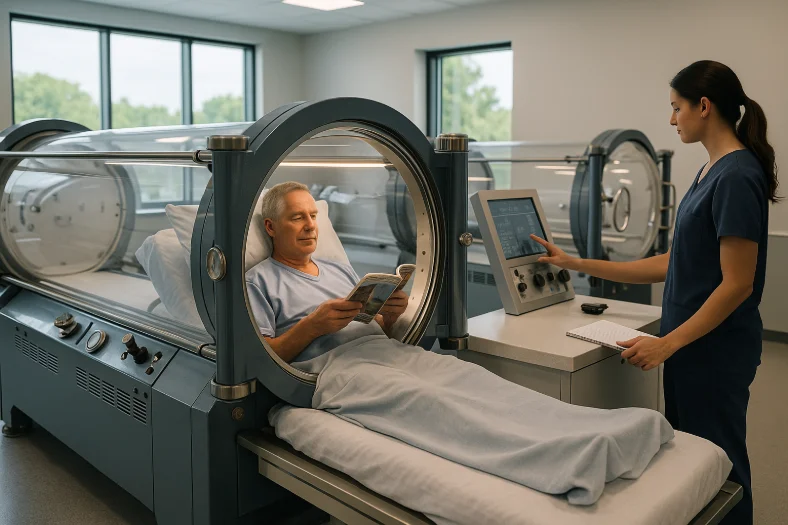

Hyperbaric oxygen treatment for stroke patients delivers pressurized oxygen under physician supervision. Stroke damages brain tissue, and recovery depends on restoring function to affected regions. Your provider explains how hyperbaric medicine supports that process, while outlining what you can expect.
Understanding Hyperbaric Oxygen Therapy
Hyperbaric oxygen treatment for stroke patients uses a pressurized chamber to increase oxygen levels in your blood. The treatment is clinical, and it relies on medical-grade equipment operated by trained staff. A physician sets the pressure and session length. Because protocols vary, your plan matches your stroke recovery needs. Each session follows a defined schedule. Before treatment begins, your provider reviews your history and current condition. This evaluation helps determine whether hyperbaric oxygen therapy is appropriate for your recovery stage.
Sessions are typically conducted in a monitored clinical setting, and staff observes you throughout each visit. Stroke can reduce circulation in brain tissue, so elevated oxygen will help support cell function in those regions. Treatment length and frequency are set by your physician and adjusted as your body responds over time. You are not expected to manage this alone; your care team guides each step and answers questions as your plan progresses.
Understanding what to expect before your first session can ease any concerns you have. You will lie comfortably inside the chamber. Then pressure gradually increases. Some patients notice mild ear pressure, and this is similar to what you might feel during a flight. Staff remain available throughout the session to address any discomfort. Knowing this in advance helps you feel prepared as your treatment begins.
Supporting Stroke Recovery
Stroke reduces oxygen supply to brain tissue, and affected cells may lose function. Because recovery is gradual, treatment occurs across sessions. Your care team monitors your response throughout each phase. Brain tissue surrounding the injury site is not always permanently damaged. Your physician tracks this and adjusts your treatment schedule based on clinical observations and your progress. The therapy is one component of a broader recovery plan. Your care team coordinates hyperbaric sessions alongside rehabilitation to keep your progress on track. Recovery looks different for each person, and your provider works with you to set realistic, condition-specific goals. A structured plan typically includes:
- Scheduled sessions: Treatment frequency is set by your physician and adjusted as your condition changes.
- Rehabilitation integration: Physical and cognitive therapy continues alongside hyperbaric sessions.
- Progress reviews: Goals are assessed regularly, and your plan is updated to reflect your current needs.
- Individualized targets: Your provider establishes measurable, condition-specific milestones to guide your care.
Combining Complementary Treatments
Hyperbaric oxygen therapy often works within a coordinated care treatment plan, and your physician determines which additional services are appropriate for your condition. No single therapy addresses all stroke recovery, so combining targeted treatments lets your care team support you more completely. Your physician selects compounds based on your condition, and dosing is monitored throughout care. This approach is not uniform; it is tailored to what your evaluation reveals. Stroke recovery increases demands on the body, and making sure your nutrition supports that process is a practical step. Treatments are selected to complement your goals, not replace established recovery methods. These options are not universal. Your care team assesses your condition first, and when combined therapies are appropriate, they are integrated under supervision.
Start Hyperbaric Oxygen Treatment For Stroke Patients
Hyperbaric oxygen therapy supports stroke recovery through structured, physician-supervised care. Speak with a qualified provider to review your history. Because every plan is individualized, your consultation will determine whether treatment fits your needs. Contact your team today to begin, and you can discuss all of your options.